Kali Uchis as a Bicultural Musician
By Jose Melendez
On March 29, 2023, shortly after the release of her album Red Moon in Venus, Colombian American artist Kali Uchis (Karly Marina Loaiza) posted this message of gratitude on Instagram to her Latin American audience: “Nunca me sentí aceptada en Latino America ni en los Estados Unidos, pero por la primera vez ustedes me hicieron sentir tan amada…y por eso les doy mil Gracias. yo desde niña been orgullosamente colombiana, y es un sueño cumplido poder compartir con ustedes this way. Les amo forever” (Italics my own). Translated to English, the message reads: “I never felt accepted in Latin America nor in the United States, but for the first time, you’ve all made me feel so loved…and for that I give you all many thanks. Ever since I was a kid I have been proudly Colombian, and it’s a dream come true to have been able to share this with you all this way. I love you all forever.”[1]
For her Spanish-speaking Latin American audience, the message begins unremarkably until one English word after another slips through the cracks. Taking language into account, Uchis’s fanbase can be split into three groups. The first, her Spanish-speaking audience, might only understand all but those few English words. The second, her English-speaking audience, might understand only those few English words. But a third group, her bilingual audience, will not only understand every word but also recognize Uchis’s mixing of language as a byproduct of her own bilingual upbringing. This audience, one in which Uchis would place herself, is her hybrid Latino American audience.
For Latino Americans, Uchis’s identity as a Colombian R&B artist from Virginia is not anomalous. Like her, many of these fans, born and/or largely raised in the United States, share a deep heritage with Latin American countries whose cultures they draw from to model their own identities. To speak Spanglish—a mix of Spanish and English—is a natural expression of this bicultural experience. In her music, Uchis takes the idea of a cultural concoction a step further in her willingness not only to mix language in her social media and lyrics, but also in her willingness to mix styles from either side of the U.S.-Mexico border and beyond.
In 2020, Uchis released her second studio album, and first Spanish-language project, Sin Miedo (del Amor y Otros Demonios). One track, “Telepatía,” became a viral sensation that propelled Uchis into becoming the first Latin artist to achieve over one billion streams on a single song.[2] Despite a number of accolades, including award nominations and the song peaking at No. 1 on Billboard’s Latin charts, “Telepatía” was not nominated for a Latin Grammy. In fact, the decision to release the song as a single at all was met with skepticism from within Uchis’s own team. Though one could only speculate as to why Uchis received no nomination, it is precisely this lack of recognition and apprehension from inside and outside her circle that has made Uchis feel, as she would allude to in her Instagram post years later, unaccepted in the Latin American market.
That “Telepatía” became a viral sensation at all is a testament to Uchis’s ability to weave her influences into her music in such a way that can cross stylistic and linguistic boundaries on both sides of the border. Musically, its instrumentation and rhythm have a more laid-back and steady feel than the genres that have traditionally dominated contemporary Latin American charts, namely reggaeton. Her music’s crossover appeal allows all musical audiences regardless of language the ability to find some aspect of her work to appreciate. Yet Uchis’s goal is not crossover appeal, but to express her bicultural identity which just so happens to cross over in English- and Spanish-speaking markets. Speaking on the motivations behind her music-making, she expresses a desire to show “all the different dimensions of [herself].”[3] While those different dimensions are particular to her, what her Latino American audience sees outside of a mere entertainer is a figure who does not selectively perform either her Colombianness or Americanness, but her Colombian Americanness.
Kali Uchis occupies a unique space in the U.S/Latin American music market as a bicultural artist that uses her hybrid upbringing to fuel her artistry. As both a Colombian and an American, Uchis flows between these cultures at will in a variety of ways. The first way is in her willingness to switch between English and Spanish in her music on a whim: sometimes for entire projects, sometimes from song to song, and sometimes within a song itself. The second way is in her willingness to mix genre, much in the same way as she uses language. Her childhood in both Colombia and the United States have exposed her to a variety of styles that she manipulates in ways that express that unique upbringing. She may, within an album, mix R&B and reggaeton, or even funk and cumbia. A last way she navigates her biculturalism is by utilizing herself as an expression of culture; through clothing, hairstyles, and more. By utilizing cultural signifiers like language, genre, and style, Kali Uchis positions herself as an intercultural artist that, despite a lack of understanding from the industry, has not only found success with English- and Spanish-speaking audiences, but has become a face of the Latino American experience.
Latin music in the global scene
By the midpoint of 2024, Latin music became the fastest growing musical genre in the United States.[4] Two of the most visible artists emerging from this new wave of popularity include Puerto Rican rapper Bad Bunny and Mexican corrido artist Peso Pluma. According to Billboard, these two artists were respectively the No. 2 and No. 5 most streamed artists globally in 2023 in a list which features 16 Latin artists total.[5] Their success has broken barriers not just in the Americas, but worldwide. Bad Bunny’s fourth studio album, Un Verano Sin Ti, was the most streamed album in both 2022 and 2023. To this day, it is the most streamed album on Spotify.[6] His follow up album, Debí Tirar Más Fotos (2025) further propelled him to the upper echelons of mainstream stardom, resulting in Billboard chart-topping singles like “DTMF,” multiple Latin Grammy wins (including Album of the Year), and six nominations in the traditional English-language Grammys, where it is also nominated for Album of the Year.[7] The most visible marker of both Bad Bunny’s and Latin music’s growing embrace in the public American conscious, though, is Bad Bunny’s selection as the headliner of Super Bowl LX’s halftime show. As the first Latin act to perform at such a culturally-significant American event, one deeply woven into the United States’ identity, it provides an undeniable indicator of Latin music’s growing stronghold among English-speaking audiences.
The reasons behind Latin music’s rapid cross-cultural success may be numerous. It could be that listeners, thanks in part to social media platforms like TikTok and a growing sense of globalization, are more open to new styles and languages all in the name of finding music to enjoy. It could also be that there is an existing cyclical sphere of influence, one in which American music-its languages, styles, and markers of culture-are being increasingly drawn from by Latin artists, and vice versa. In other words, English-speaking American listeners may be starting to find commonalities in Latin music that draw them in, and that they can relate to on a level that might not be possible were those commonalities not present. This hybridization of cultures then allows non-Spanish speaking audiences to, at the very least, enjoy all aspects of Latin music except language, which forces listening to itself be decontextualized. This is not to say that contextualization is necessarily important in such cases: rather, that the functions of this music removed from language become largely limited to entertainment.
In addition to an increase in Latin music in the U.S., the presence of Latinos in the U.S. is also growing, propelling them to become the largest minority group in the country. The Pew Research Center has reported a population of 62.5 million Latinos in the U.S. in 2021, making up 19% of the population. This is a growing number, increasing from 14.8 million in 1980, which made up just 7% of the population then.[8] The popularity of Latin music in the United States and the United States’s Latino population are seemingly growing hand-in-hand to new heights. Further, I do not mean to imply that the U.S’s Latin population directly accounts for Latin music’s American success. After all, Latinos are not a monolith: Latinos in the U.S. do not only listen to Latin music, if at all. At the same time, it would not be surprising for a growing minority population to retain its own culture in their new home on the other side of the border, rather than simply adopting a new, dominant culture. Crucially, there is one population that toes the line between both a dominant, U.S.-based culture and a Latino subculture: Latino Americans.
Brief Note on Vocabulary
Until now, I have been using the word “Latino” to describe those with an ancestry that can be traced back to Latin America. I believe it important to recognize here the issue of terminology and how those with Latin American ancestry represent themselves.
There are a number of terms used by members of this group to describe themselves; Latino/a/e, Hispanic, Chicano/a/e, and many more, with variations. Such terms are rich in their connections to politics, geography, language, etc. The origins of these terms are equally varied, in that some were ascribed to them by outside populations (such as the term “Hispanic” being coined by the U.S. Census)[9] or coined themselves. The decision to use one term to describe oneself over another is a process those within the community undergo themselves, and I recognize that in picking one over another, I am removing the agency of those who would rather describe themselves with another term. However, I am picking “Latino” for a number of reasons. One is because I am choosing to focus on, for the purposes of this paper, Spanish-speaking Latin American countries (I am excluding countries in Latin America that do not speak Spanish, including Brazil, Guyana, Suriname, and French Guiana, as well as indigenous populations). Another reason is because I am centering the Spanish language predominately in this paper and feel it appropriate to use a term that retains that origin. Lastly, I use this term because it relates closely to another term that I will soon introduce, Latinidad, and believe that it would help the reader in keeping track of terms.
I also recognize a growing push to offer gender-neutral alternatives to those terms that have origins in the Spanish language. I choose not to use the still-prevalent “Latinx” because of what I perceive to be its problematic appropriation of a term that was meant not to represent all Latinos, but to represent a Latino transgender community.[10] I applaud the alternative “Latine” to represent a wider gender-neutral population of people with Latin American heritage, but I believe that my use of “Latino” in “Latino American” (which I also use as a gender-neutral term) will be a more appropriate selection, as my subject Kali Uchis both uses “Latino” and is a cisgender woman.
Latino Americans, Latinidad, and Spanglish
Latino Americans are people born in the United States that have Latin American ancestry. Of the 62.5 million Latinos in the U.S. in 2021, 42.6 million were U.S.-born, comprising around 68% of that population.[11] Yet despite being both “Latino” and “American,” Latino Americanness is a distinct classification separate from both these cultures, though this is not to say that they do not share commonalities. This is not a case of two halves making a whole identity—it is a hybrid identity in itself. In recent years, the marketing term “two hundred-percenter” has gained traction as a reflection of this philosophy, in that these people view themselves as being 100% Latino and 100% American.[12]
Despite an inherent feeling of full-Latino heritage, Latino Americans are in a constant struggle to prove their authenticity, or Latinidad (Latinness), in Spanish-speaking circles, just as they are in a struggle to prove their Americanness in U.S. circles. Latinidad, for many Latino Americans, is a term that is inherently problematic and imposes an impossible standard. For these people, Latinidad points to a monolithic view of Latino Americanness that does not accurately take into account the varied histories and cultures of each country. It also implies that there is some level of Latinidad that is necessary within all people of Latin America/Latin American heritage. Of course, the question then becomes: who decides?
I will argue that, despite Latinidad being a zero-sum aspiration that awkwardly positions Latino Americans as being in a constant state of authentication, it is an aspiration, nonetheless. Especially in the United States, where pockets of Latin American communities may be few and far between, the desire to fit in and prove one’s belonging remains a motivational force.
Perhaps the most audible expression of a biculturalism can be found in language, particularly in Spanglish. Spanglish is, in general terms, the mixing of English and Spanish. Within Spanish-speaking circles, it is seen as a negative practice that reflects some lack of intelligence on the part of the speaker. According to Ana Celia Zentella,
Attacks on Spanglish reflect the ways in which negative attitudes toward diverse ways of speaking perpetuate inequities: the “standard language” of the elite is considered superior to the disparaged ways of speaking of the working masses, and many believe that those who speak “correctly” are better prepared for life, even better people.[13]
Such antiquated mentalities about language speak just as much to similar mentalities of culture and Latinidad. To be Latino American in the United States (i.e. far from one’s country of heritage) is to be in a constant struggle for approval. This struggle can be distilled down to a phrase: “Ni de aquí, ni de allá” (“Not from here nor there”). Such a feeling could be further complicated when one’s hometown is split across countries, as was the case with Kali Uchis.
Kali Uchis’s upbringing
Karly Marina Loaiza was born in Alexandria, Virginia, on July 17, 1994. The daughter of a Colombian father and an American mother, her family moved to Pereira, Colombia, and then moved back to the United States while Loaiza was still in grade school. It was in Virginia that she would begin to absorb more American musical influences after beginning to listen to music in Colombia: “On the one hand, there were artists like N.E.R.D, Missy Elliott, and Aaliyah, and on the other hand a lot of Colombian music, with bolero and perreo songs.”[14]
Perhaps more than anything, it is Uchis’s time in Colombia that has most influenced the way that she makes music. This shows itself not only in the way she weaves styles of music, but also in her writing process:
So much of what I do in my work in Latin music is based around expanding and giving insight into the types of music I listened to growing up in Colombia. When people think of a Latin artist, they think of one particular sound, when actually it’s so many genres…I grew up reading and writing in Spanish before English. I went to school in Colombia for years and then I came back and went to school in the United States. I had the bicultural experience, and it’s deeply embedded in my writing process. [15]
Kali Uchis and Spanglish
Despite Spanish being her first language, Uchis equally spoke English, thanks in large part to her English teacher father.[16] With such a seemingly equal command of either language, it would seem natural to be able to integrate one language into her writing at a time. However, Uchis’s mixing of English and Spanish—or here, Spanglish—is what comes most naturally to her. At one point, her own perceived lack of ability in writing fully in Spanish kept her back: “I didn’t feel completely confident about my writing yet to make fully Spanish songs; that’s why I write so much bilingual.”[17]Ability aside, Spanglish is what she perceives to be her most authentic self: “I grew up bilingual, speaking Spanglish in my house, so it would be inauthentic to sing completely in Spanish or in English because that’s not how I talk.”[18]
Uchis is not alone in her use of Spanglish as a reflection of her bicultural upbringing. Omar Apollo, a frequent collaborator of Uchis and a Latino American of Mexican heritage, is also familiar with that same mixed use of language: “There’s so many bilingual, first-generation Latinos in America that speak the way we do and have the same background. It’s its own subculture of Latinos, and I think a lot of people relate to that.”[19] Uchis takes singing both languages and shaping her work around them as a very serious task that not only reflects that unique upbringing, but is the truest representation of herself, to the point that she has described individual albums in which she primarily sings in English or Spanish as “scrapbooks.”[20] Part of this decision to mix also comes from a desire to push back against the idea of a monolithic Latinidad, particularly when it comes to the recording industry’s views on Latin music and its distinctions in genre. According to Diego Ortíz of Rolling Stone Colombia, “The Latin industry is so married to genres — they prefer strictly defined sounds. It has to be reggaeton or pop or rock.”[21]
Despite her success in the English-speaking market as a Latina woman, there is a sense of othering that the Spanish-speaking markets, particularly in how they market her, engage in. One Spanish-language interview even adds a disclaimer of sorts explaining Uchis’s use of Spanglish, despite describing Latin America as Uchis’s native environment only a sentence before:
However, it is inevitable that, in her music, the lyrics are written in Spanglish, as will happen in most of our interview. This act, the mixing of language, is a reflection in itself of the essence of Kali and of her two-headed education—converted into double nationality—between Colombia and the United States, the country she moved to as an adolescent.[22]
Interestingly, it is only in these Spanish-language interviews where references to her American mother seem relevant enough to be mentioned, where they would be few and far between in English-speaking interviews.[23]
Kali Uchis and defying genre
Because of those various styles of music that Uchis grew up listening to in both Colombia and the United States, mixing genre is another way of expressing what Uchis views as her true, artistic self. In fact, she believes her music to be genre-less and refuses to ascribe any stylistic characteristics to her music beyond how it might make her feel. Even when asked by Spanish-speaking interviewers about the genre of her music, she deflects and instead describes her process in multimodal terms: “I’ve never defined my music, because it doesn’t belong to any genre. I identify myself with emotions. And basically I see music like the art of cinema.”[24]
The decision to make her second album, Sin Miedo a Spanish-language project gave Uchis the opportunity to directly index her Latin music influences. In a sense, Uchis has played the role of cultural tastemaker since the beginnings of her career, singing covers in Spanish to audiences that initially flocked to her for her English-language material.[25]Part of this choice was artistic, but part of it was also to shed light on Latin music being more than what it is perceived to be by English-speaking audiences: “[Anglophone audiences] don’t know anything about the roots of Latin music — they think Latin music should just sound like, riki-tiki-ta!” she trills, rolling her eyes.”[26]
In Sin Miedo, Uchis experiments with a number of Latin styles, including bolero, perreo, reggaeton and more. The first track, “la luna enamorada,” is a cover of a song by Colombian group Los Zafridos. Her singing style here takes a deeper, chest-voice approach that makes Uchis sound more like a crooner than in her previously successful English-language project, the debut album Isolation. A trap song, “¡aquí yo mando!” sees Uchis take a more authoritative voice, a woman claiming power as reflected in the title, which translates to “Here, I’m the boss.” Continuing her role as a tastemaker, Uchis collaborates with Rico Nasty, a rapper known in the English-speaking music world but less known for her background as an Afro Latina. For Uchis, Nasty’s inclusion further expands the idea of who can be Latino and claim a Latinidad:
“And then also the fact that she was Afro-Latina, I felt like I wanted to introduce her to people who may not know her in Latin America. She is Puerto Rican but she doesn’t know Spanish, so it was really fun to be able to teach her Spanish and write it with her. I do feel like it was something so necessary, especially for the time period we’re in. I think it’s so important that we have representation and that we feel very proud of where we come from and proud to speak Spanish and proud to be a united front.”[27]
Ultimately, Sin Miedo is Uchis’s attempt at creating art that is not only representative of her, but representative of her influences. In interviews, Uchis hints at criticism surrounding her decision to write an album stylistically and linguistically different from the previous works that afforded her an audience. In the face of these criticisms, Uchis believes the risk was worth taking in order to showcase her versatility: “What feels most authentic to me is going between languages and being able to push between genres because that’s actually where I come from. This album was about being able to showcase my versatility and pay homage by honoring all of the different genres that were part of my Latin American heritage and identity.”[28]
Kali Uchis and Colombian style
In addition to music, Uchis has utilized fashion as another method of self-expression and direct visual allusion to her artistic influences. In the beginning of her career, for instance, Uchis relied on a more American retro style, dyeing her hair a Marilyn Monroe-like platinum blonde and wearing Christian Roth clout goggles, much like the ones Kurt Cobain would come to reintroduce to a new generation in the 1990s. As she developed more and more of a Latin American audience, however, this style shifted from an American ideal of retro to a Colombian retro with splashes of contemporary style. Her clothing has become more revealing, opting for more form-fitting dresses and high heels. She has even aligned more closely with Colombian beauty standards of the female body, which, generally speaking, glorifies more voluptuous silhouettes. I intend this less as a personal commentary and more to initiate a discussion on the fetishization of Latin women, particularly in Colombia.[29] In other words, Uchis’s rise in success in Latin American markets has corresponded with her body transforming into one that is more aligned with, generally speaking, Colombian female beauty standards.
Like Latina artists before her, Uchis’s appearance has become another facet of marketability for Spanish-speaking and, to an extent, English-speaking markets. There has long been a history of sexualizing, fetishizing, and exoticizing female Latina stars, as has been the case with artists like Jennifer Lopez. I will not argue here that Uchis has sexualized herself to open up her Latin American audience. Instead, I argue that she uses fashion and (stereo)typical Colombian dress to express her Colombianness and therefore express her Latinidad.
In particular, I look towards Uchis’s recent forays into the jean market, one which is largely associated with Colombian women. Bodied by Uchis is a clothing line founded by Uchis in 2021. Particularly, I would like to call attention to a collection of jeans curated by Uchis and dubbed Obsesión Denim. This collection, produced in Colombia and inspired by Colombian street style, consists of levanta cola (“butt lifting”) jeans, which are form-fitting and meant to make one’s butt look bigger.[30] The desire to make the butt look bigger, a hallmark of Colombian beauty standards, is one such way in which Uchis plays with the female body and fashion to signify a familiarity with Colombian culture.
Telepatía as a case study
With Kali Uchis’s use of language, genre, and style in mind, I would like to look at the music video for “Telepatía” as an example that synthesizes all three of these elements. In identifying how she utilizes each element to express her Latino Americanness—here meaning her Colombian identity and her American identity in tandem—I hope to illustrate how the unique and sometimes seemingly silent ways she performs biculturalism are exemplary to her fans who share the same identity.
The music video begins with a title card in a hot pink-colored script font against a deep red background. Immediately, the song begins with an electronic drum fill and groove-inducing subbass supporting an ethereal, airy synthesizer and a droning stringed note right behind. Immediately, the song’s instrumentation departs starkly from the rest of the contemporary Latin pop landscape, one dominated by reggaeton rhythms and Mexican-inspired horn riffs. Instead, this sound draws more from dream pop and R&B, transporting the listener away from the sweaty dance floor and into a sophisticated, contemplative space. The drums, in particular, became a point of contention during the decision to release “Telepatía” as a single. Among the biggest suggestions made to make the song more palatable for Latin audiences was a change in the drum sound, which did not occur.[31] Unlike the drum sound found in a great deal of contemporary Latin pop, the drums in “Telepatía” are much deeper and without as much high end.
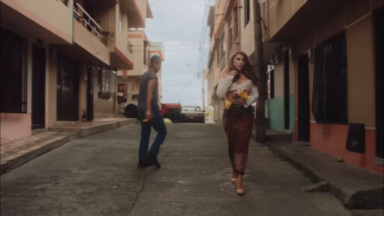
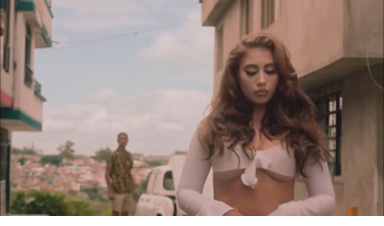
Visually, we see Uchis in Pereira, her Colombian hometown. She is dressed in a long, warm-colored patterned skirt, small, white crop top, and wearing heels holding a bouquet of flowers. Her hair is long, wavy, and an auburn light brown. This look updates the image of the stereotypical Latina woman: pure, innocent, and exoticized. Uchis here plays with color and pattern in her skirt and shirt to recall images of a village woman, turning her into just another Colombian woman like any other—with zero attention being paid to her potential Americanness.
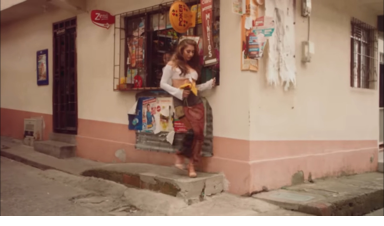
The idea of Uchis portraying herself as a Colombian is something she has maintained in interviews: “I’m a simple girl, I like rice and beans with an egg on top, and for breakfast, I love arepas or ‘calentados’ [a Colombian dish]. My favorite music are boleros, Colombian cumbia and perreo.”[32] Yet, as she walks, those that walk past her cannot help but keep their eyes locked on her. It could be inferred that the men that look at her are doing so in an objectifying manner. However, I would like to offer the alternate interpretation that, instead, or in addition, these people are looking at Uchis as an other: as someone that, despite how they look, may not belong. Only until she starts singing does she begin to walk the street alone, with the only person she encounters looking her up and down.
In the next shot, Uchis is wearing a different outfit, red with an alternating red and white/blue background. It is a much more intimate, lingerie-like outfit, yet one that would not look out of place on a modern-day pop star. She holds a feathered fan to her face, recalling even further the idea of a pop diva. Interestingly, she does not sing during this shot until the beginning of the pre-chorus, which is sung half in English. The contrast between the white/blue-background Spanish-language parts and red-background English-language parts could be a comment on purity versus corruption or instead could be seen as expressing plain difference. One language sings one part, another sings the other—they both support each other.

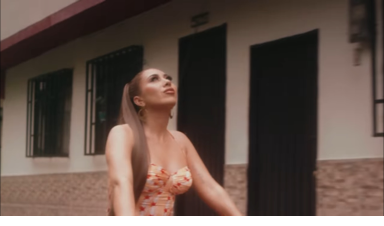
The next scene takes place in the second half of the pre-chorus, which repeats many of the same elements as the first. But here, Uchis is in yet another location and in yet another outfit. She is walking a bicycle uphill, wearing a long ponytail, a patterned tank top and a very short, red skirt. It feels like this is a combination of the last two outfits, but with more color and less fabric. Uchis plays a bit more here with a Colombian sexuality, cheekily alluding to the danger of riding a bicycle while wearing a very short skirt as she rides past Colombian men. She takes a break from riding her bicycle to walk and look at her surroundings. Once Uchis starts riding the bicycle, however, she turns from a villager to a full-on tourist, if only briefly. In one frame, she can be seen looking up at wonder, perhaps noticing details she had never seen before or might not have seen since her last visit.
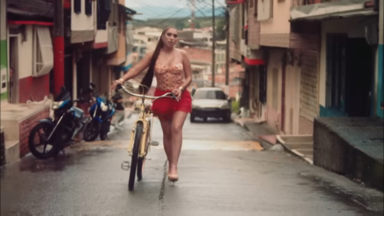
As the chorus begins, the instrumentation retains much of the same elements but also introduces a lightly strummed acoustic guitar. The acoustic guitar is an instrument often utilized in a variety of Latin American and Spanish genres, such as bolero, bossa nova, flamenco, and many more. The connection between the acoustic guitar and these genres, ones often driven by lyrical themes of romance, can be read as similarly connecting Uchis to a tradition of songs of love. The romance ascribed to the instrument lines up narratively with the song, especially as the lyrics of the chorus wonder what the author would do if they could make love telepathically, across long distances. In playing the strings so languidly, the percussive sound of a thumb or guitar pick hitting the strings is more audible. But the slow strum also suggests that the instrument is meant to be noticed, not simply heard. Here the point is less that there is an acoustic guitar being played in the song, but rather that it is being played at all.
The post-chorus also plays with the instrumentation used thus far. In the second half of the pre-chorus, a percussive, bongo-like instrument is introduced. Like the drums found in the rest of the song, it is deep, reverberated, and without a lot of high end. Yet, the high-pitched hollowness of the instrument can still be heard, as it beats what feels like a heart’s pulse. The bridge adds a flange-like effect to the instrumentation, putting the listener into a momentary trance. Visually, Uchis has received attention from a certain male village resident, who has found her on top of a hill swinging on a swing set as she locks eyes with him. Swinging on the swing set could further play with this idea of purity and innocence that Uchis has been hinting at. This may be a sexual purity or innocence, but I would argue this could also be easily read as a purity and innocence in relation to the environment. Perhaps a better word here could be comfort towards the environment. She is comfortable enough to wear what she wears and ride where she rides because, to her, this is home. Yet, if this was fully her home, why is there a man following her with such curiosity? Surely this village being her home would mean she is known to everyone? Despite how she may see her position in the village, she is still having to contend with feeling like an other. She is in a constant state of having to prove her inclusion in the community.
Conclusion
In her work, Kali Uchis uses references to language, style, and fashion to express her status as an intercultural artist in ways that those sharing the Latino American experience can most closely relate to. She is able to do this despite a lack of understanding by the English- and Spanish-speaking markets on how to sell her work. Though “Telepatía” was a hit, it was against all odds. This success went against the genre-divided approach Diego Ortíz mentioned ran rampant in the Latin music market. Instead of succumbing to this approach and to suggestions made to make her music more like the music already on the market, Uchis instead embraced what made her music not like what was already on the market.
Uchis was able to subvert this idea of what made Latin music Latin in “Telepatía.” In contrast to the reggaeton rhythms and tonalities found in contemporary Latin percussion, Uchis instead draws from dream pop and R&B to set the ethereal mood of the song. She also includes parts in English, perhaps the most obvious signifier of her American self. Yet, Spanish-speaking Latin audiences found no problem with its inclusion, seeing Uchis as one of their own. The music video for “Telepatía,” filmed in her village of Pereia, Colombia, further plays with this idea of inclusion. Though she makes the conscious effort to spotlight her village, she is also portrayed as something of an outsider. As much as she may look the part of a typical Colombian woman, those in her village placed unusual attention on her. Though some of this attention may be because of her representations of Colombian beauty, some of it could also be out of curiosity of who this woman could be.
As Kali Uchis plays more and more with language and genre in her music, it is important to reaffirm that her experience is unique to her, and that it does not represent what the life of every bicultural Latino American is like. Yet, that is also precisely the point. Uchis’s influences and ways of expressing herself are individual because her experience is individual. Latino Americanness is a constant struggle, one where identity is being pulled in multiple directions. It is this struggle that makes the experience one that cannot be marketed or synthesized. What Kali Uchis offers is the idea that any Latinidad she has is inherently in her work and in her life, so much so that it is not something she must proclaim every day. The issue which Uchis and people like her face is the belief that the opposite is true.
[1] “(@kaliuchis) • Instagram Photos and Videos,” March 29, 2023, https://www.instagram.com/kaliuchis/. Unless otherwise noted, all translations are my own.
[2] Tirhakah Love, “Kali Uchis Had a Vision,” Vulture, January 4, 2024, https://www.vulture.com/article/kali-uchis-orquideas-interview.html.
[3] Luis Luna, “How I Made It: Kali Uchis,” Latino USA, May 25, 2021, https://www.latinousa.org/2021/05/25/kaliuchis/.
[4] Cerys Davies, “Latin Music Takes the Lead as the U.S.’s Fastest-Growing Genre,” Los Angeles Times, July 18, 2024, https://www.latimes.com/delos/story/2024-07-18/latin-music-growth-us-musica-mexicana-fuerza-regida-peso-pluma.
[5] Isabela Raygoza, “Bad Bunny Has Spotify’s Most Streamed Album Globally of 2023,” Billboard, November 29, 2023, https://www.billboard.com/music/latin/bad-bunny-spotify-most-streamed-album-globally-2023-1235515689/.
[6] Raygoza, “Bad Bunny.”
[7] At the time of writing, the 68th Annual Grammy Awards have not yet taken place.
[8] Mohamad Moslimani and Luis Noe-Bustamante, “Facts on Latinos in the U.S.,” Pew Research Center, August 16, 2023, https://www.pewresearch.org/race-and-ethnicity/fact-sheet/latinos-in-the-us-fact-sheet/..
[9] Kaitlin Smith, “Latinx vs. Hispanic: A History of Terms | Facing History & Ourselves,” October 15, 2021, https://www.facinghistory.org/ideas-week/latinx-vs-hispanic-history-terms.
[10] For further perspective into the effect of “Latinx” on transgender communities, I offer Alan Palaez Lopez, “The X In Latinx Is A Wound, Not A Trend,” Color Bloq: The Stories of Us, accessed January 14, 2025, https://www.colorbloq.org/the-x-in-latinx-is-a-wound-not-a-trend.
[11] “Facts on Latinos in the U.S.”
[12] Suzy Exposito, “Diaspora Baby: What Makes U.S. Latinos so Hard to Define?,” Los Angeles Times, July 10, 2023, https://www.latimes.com/delos/story/2023-07-09/latinos-marketing-the-200-percent.
[13] “55. Spanglish: Ana Celia Zentella,” in Keywords for Latina/o Studies, ed. Deborah R. Vargas et al. (New York University Press, 2017), https://doi-org.proxy.lib.umich.edu/10.18574/nyu/9781479892532.001.0001.
[14] Naomi Clément, “Interview with Kali Uchis, queen of Latin American R’n’B,” Magazine Antidote, November 12, 2021, http:///musique/kali-uchis-interview/.
[15] Love, “Kali Uchis Had a Vision.”
[16] Suzy Exposito, “Pop Loner Kali Uchis on Growing Up Punk in Colombia and the Struggle to Stay Bilingual,” Rolling Stone, July 24, 2018, https://www.rollingstone.com/music/music-latin/kali-uchis-isolation-colombia-interview-2018-700772/.
[17] “Kali Uchis On Her Road To ‘Orquídeas’: How A Bicultural Mindset, Working Alone & Embracing Her ‘Bitchier Side’ Resulted In Her Most Energetic Album | GRAMMY.Com,” accessed January 5, 2025, https://grammy.com/news/kali-uchis-interview-orquideas-new-album-videos.
[18] David Smyth, “Kali Uchis Interview: ‘My Career Has Been Full of Mistakes,’” The Standard, October 16, 2020, https://www.standard.co.uk/culture/music/kali-uchis-interview-2020-a4571899.html.
[19] Jon Pareles, “Kali Uchis Is a Complicated Musician. She Plans to Stay That Way.,” Arts, The New York Times, April 19, 2023, https://www.nytimes.com/2023/04/19/arts/music/kali-uchis-red-moon-in-venus.html.
[20] Pareles, “Kali Uchis Is a Complicated Musician. She Plans to Stay That Way.”
[21] Suzy Exposito, “A Musical Shapeshifter with Universal Ambitions, Kali Uchis Aims ‘to Show What Latin Music Can Be,’” Los Angeles Times, December 30, 2020, https://www.latimes.com/entertainment-arts/music/story/2020-12-30/kali-uchis-latin-sin-miedo.
[22] F. Javier Girela, “Kali Uchis: ‘Siento que mi misión es que vean a las mujeres latinas de una forma más amplia, porque las expectativas sobre nosotras están más altas que las de un hombre americano blanco,’” GQ España, January 25, 2024, https://www.revistagq.com/articulo/kali-uchis-orquideas-nuevo-disco-entrevista. Original text: Sin embargo, es inevitable que, en la mayoría de ellos, las letras tornen en Spanglish, como sucederá a lo largo de nuestra entrevista. Este hecho, el de la mezcla en la lengua, es reflejo en sí mismo de la esencia de Kali y de su educación bicéfala –convertida en doble nacionalidad– entre Colombia y Estados Unidos, país al que se mudó siendo adolescente.
[23] Natalia Tamayo Gaviria, “‘Mi trabajo es ser una artista, ser honesta y genuina’: Kali Uchis,” El Tiempo, February 3, 2024, https://www.eltiempo.com/cultura/musica-y-libros/kali-uchis-habla-de-su-musica-y-su-nuevo-disco-orquideas-851129.
[24] Gaviria, “‘Mi trabajo es ser una artista, ser honesta y genuina.’” Original text is: “Yo nunca he definido mi música, porque no pertenece a ningún género. Yo me identifico con emociones. Y básicamente veo mi música como el arte del cine.”
[25] Codinha, “Kali Uchis Is What the World Needs Now.”
[26] Exposito, “A Musical Shapeshifter with Universal Ambitions, Kali Uchis Aims ‘to Show What Latin Music Can Be.’”
[27] Kali Uchis “How I Made It: Kali Uchis,” interview by Maria Hinojosa, Latino USA, May 25, 2021, podcast audio, https://www.latinousa.org/2021/05/25/kaliuchis/: 14:51.
[28] “Kali Uchis Makes Music Without Fear,” W Magazine, December 21, 2020, https://www.wmagazine.com/story/kali-uchis-sin-miedo-interview.
[29] Further discussion on the fetishization of Latina bodies in American media, particularly, can be found in Isabel Molina-Guzman, Dangerous Curves: Latina Bodies in the Media (NYU Press, 2010). Discussions on Latin female beauty standards, as well as the pressures Latinas feel to meet them, can be found in Elisabeth Gruber et al., “A complex conceptualization of beauty in Latinx women: A mixed methods study,” Body Image 41 (2022): 432-442: https://doi.org/10.1016/j.bodyim.2022.04.008.
[30] “Kali Uchis Wants to Celebrate Latinx Bodies,” Harper’s BAZAAR, September 27, 2021, https://www.harpersbazaar.com/fashion/designers/a37625530/kali-uchis-bodied-by-uchis-interview/.
[31] Love, “Kali Uchis Had a Vision.”
[32] José Forteza, “La colombiana Kali Uchis revela a Vogue el éxito detrás de Telepatía,” Vogue, July 12, 2021, https://www.vogue.mx/estilo-de-vida/articulo/kali-uchis-habla-del-exito-de-telepatia-en-entrevista. Original text: Soy una chica simple, me gusta el arroz con frijoles y con un huevo por encima y, de desayuno, me encantan las arepas o ‘calentado’. Mi música favorita son los boleros, la cumbia colombiana y el perreo.